

Stumbling into Memory
2026
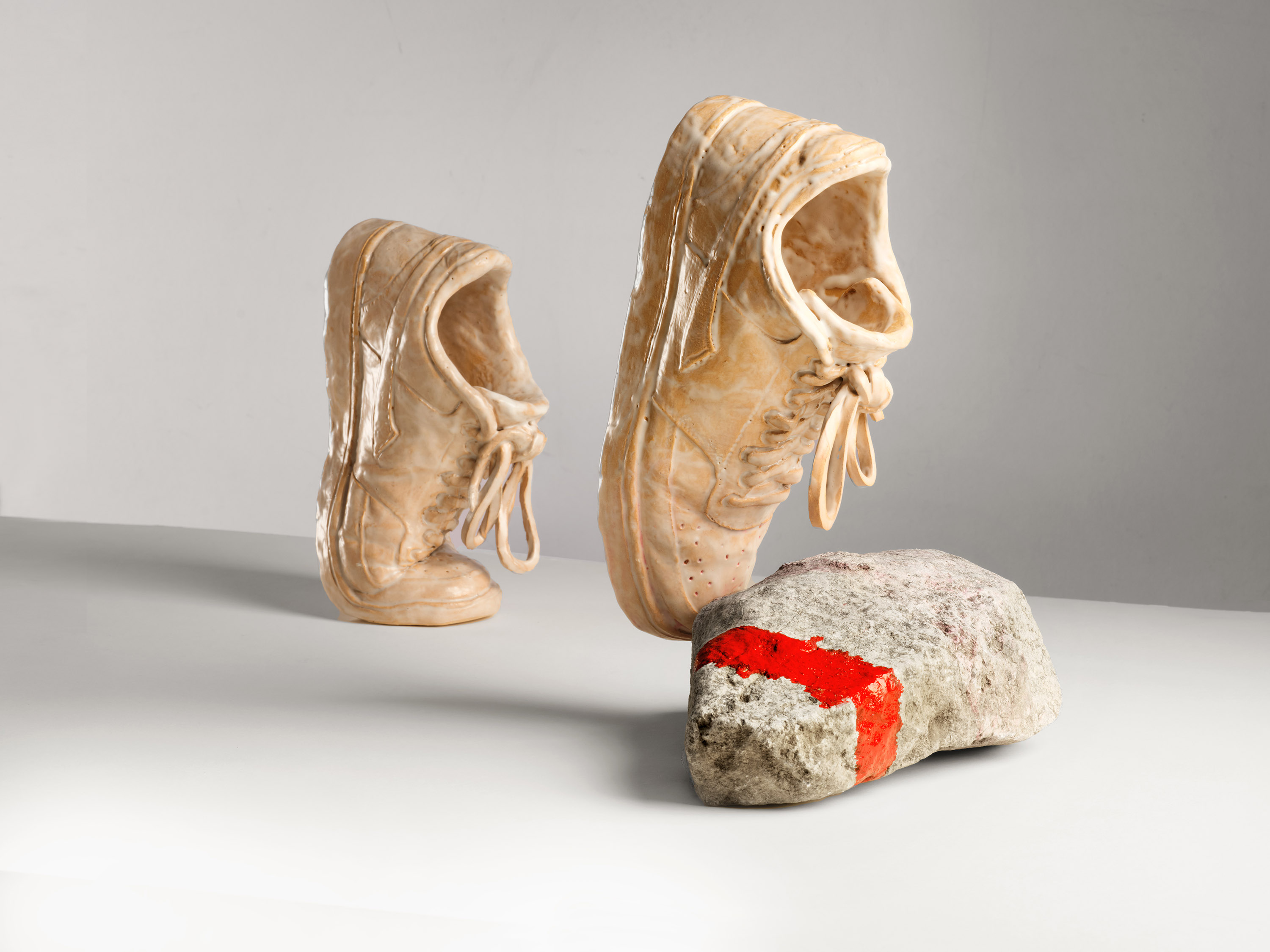
Created by bringing ceramic and stone together, this composition began as a reflection on gender-based violence, but opens onto a broader consideration of the violence that runs through human relationships.
Two ceramic sneakers, caught in the act of stumbling against a stone, become the protagonists of a scene that is spare yet rich in meaning. These are not explicitly women’s shoes: they are universal footwear, part of a style that now crosses boundaries and genders. This deliberate choice suggests that violence, although it takes different forms in different contexts, often has its roots in a shared attitude: an excessive desire to possess, control and dominate another person.
Gender-based violence is thus also understood as an expression of a wider culture of domination, in which another person ceases to be recognized as a free individual and becomes something to hold on to, govern and possess. It is the boundary crossed between love and possession, relationship and domination, closeness and abuse.
The shoes, symbols of movement, freedom and each person’s own path, seem to come to a sudden halt before a stone. This is no ordinary stone: it was recovered from a place where a young woman’s life came to an end. It therefore carries a tangible, painful and irreplaceable memory. It is a silent presence, yet one charged with the trace of what happened: a fragment of a place transformed into testimony.
The stone represents an obstacle, violence and oppression, but also the weight of a memory that cannot be ignored. Its material symbolically holds the pain of a life cut short and gives the work a connection to reality, to a story and to an absence. It is more than a stone: it is a sign, a secular relic, something that makes us stop and confront what must not be forgotten.
Stumbling becomes a powerful metaphor: a step interrupted, freedom denied, a path diverted by someone who claims the right to decide for another person. Yet it is also an invitation to pause and reflect, to recognize the signs of possession and control that so often precede violence. Stumbling into memory is therefore also a stumbling of the conscience: something that interrupts indifference and prevents us from carrying on as though nothing had happened.
Ceramic and stone enter into a dialogue of materials and symbols. Ceramic, shaped by hand and only apparently fragile, preserves the trace of human gestures and recalls the vulnerability of existence. Stone, solid and enduring, evokes the weight of what obstructs and wounds, but also the persistence of memory. Together, the two materials connect the fragility of life with the harshness of violence, and the present of the work with the past held by the place from which the stone came.
On the occasion of the International Day for the Elimination of Violence against Women, “Stumbling into Memory” invites us to remember and, above all, to question ourselves. Violence against women cannot be treated as an isolated phenomenon: it is part of a broader culture that mistakes possession for love and control for a right.
The stone, carrying the memory of the place that held it, makes visible what so often risks being erased. To remember is therefore to recognize, understand and transform. It means affirming that no one belongs to anyone else, that every person has the right to follow their own path, and that no desire for possession can justify denying another person’s freedom.
The sneakers remain still before the stone, but their halted movement does not represent only an ending. It can also become a moment of awareness: the point at which we stop, look at what happened and choose not to let it happen again.
